


US Business Investment Visa: Complete Guide for Entrepreneurs and Investors
A US business investment visa lets you live in America while you build, buy, or run a company there. It is a strong fit for founders and business owners who want to be hands-on, not just park money in a fund. This guide covers the two main active routes, the E-2 and L-1 visas, and explains how they differ from passive residency options. At Canadian Management Consultants (CMC), we help entrepreneurs choose the right path before they commit capital.
What Is a US Business Investment Visa?
There is no single visa with this name. The term covers several visas that let you enter the US because of a business you own, invest in, or manage. For active entrepreneurs, the two main options are:
- E-2 Treaty Investor Visa: for investors who put substantial capital into a US business and direct its operations.
- L-1 Intra-Company Transferee Visa: for owners and senior managers who expand an existing overseas company into the US.
Both visas are temporary, but they work differently. The E-2 depends on your nationality and your investment. The L-1 depends on your existing company and your role in it.
US Business Investment Visa Requirements
The core US business investment visa requirements for the E-2 route are:
Requirement |
What it means in practice |
Treaty nationality |
You must hold a passport from a country that has an E-2 treaty with the US |
Substantial, at-risk capital |
The money must be committed and exposed to real business risk, and it must be large enough for the type of business |
Real, operating business |
A active enterprise that sells goods or services for profit, not a shell or passive holding |
Not marginal |
The business should do more than support you and your family |
Control |
You hold at least 50% ownership or operational control |
Direct role |
You develop and direct the business day to day |
Business plan |
A viable plan, ideally with five-year projections |
A note for UAE-based investors: the UAE does not currently have an E-2 treaty with the US. If you are a UAE resident, your qualification depends on your passport. Holders of a treaty-country passport can qualify, and those without one often look at the L-1 route instead. Always check this first. It saves time and money.
You will also need proof that your funds came from legal sources. The US government reviews the paper trail closely.
E-2 Treaty Investor Visa: Run the Business You Buy
The E-2 suits entrepreneurs who want to buy or start a company and manage it themselves. There is no fixed minimum investment. Instead, the amount must be “substantial” compared with the total cost of the business. A smaller business usually needs a higher percentage of its cost invested. A larger one allows more flexibility.
Here is what the E-2 offers:
- An initial stay of up to two years, with renewals in two-year steps for as long as you meet the requirements.
- Work authorization for your spouse.
- Freedom to expand, hire, and grow the company.
The main limit is that the E-2 is a nonimmigrant visa. You must show you intend to leave the US when your status ends, so it does not lead directly to a green card. You can review the official eligibility rules on the USCIS E-2 Treaty Investors page.
L-1 Visa: Expand Your Existing Company to the US
If you already own or manage a business abroad, the L-1 may be the more practical choice. It does not depend on treaty nationality, which makes it relevant for many UAE entrepreneurs.
Basic eligibility
- Your overseas company must have a qualifying relationship with the US entity (parent, branch, subsidiary, or affiliate).
- You must have worked for that company abroad for at least one continuous year within the last three years.
- You need to have occupied a managerial, executive, or expert knowledge position.
The New Office route
When the US company is brand new, you apply under the L-1 New Office provision. The first approval is usually shorter, around one year. After that, you must show the US office is up and running, with real operations, staff, and revenue, to extend your stay.
Why founders like it
The L-1A (managers and executives) can run for up to seven years. It also allows dual intent, so it can support a later green card application, including an employment-based route for multinational managers.
Business Investment in USA: Three Practical Routes
Once you know which visa fits, the next question is how to enter the market. These are the most common routes for business investment in USA:
Route |
Best for |
Key point |
American branch or subsidiary |
Owners of established foreign companies |
Works well with the L-1. You control the brand, pricing, and growth plan. |
Existing franchise |
Investors who want a proven model |
Can suit the E-2 if you actively manage it. Review the franchise agreement and financials carefully. |
Joint venture |
Founders who want a local partner |
Splits cost and risk. Make sure your ownership and control still meet visa rules. |
Whichever route you take, build the plan around visa rules from day one. Many refusals happen because the business was set up first and the immigration strategy came second.
Comparing Active US Visas and Passive Residency Options
Active routes suit people who want to run a business, but they come with ongoing duties. Passive residency routes suit people who want permanent status without daily operations.
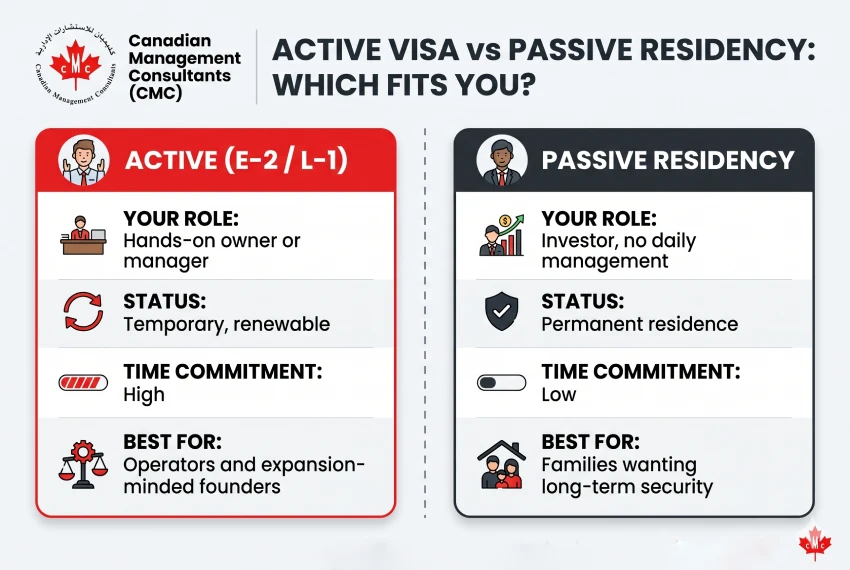
Feature |
Active (E-2 / L-1) |
Passive residency |
Your role |
Hands-on owner or manager |
Investor, no daily management |
Status |
Temporary, renewable |
Permanent residence |
Time commitment |
High |
Low |
Best for |
Operators and expansion-minded founders |
Families wanting long-term security |
Neither path is better in every case. The right choice depends on your goals, your passport, your timeline, and how involved you want to be. If you are curious about the passive side, our guides on the EB-5 visa guide and EB-5 processing time cover it in depth.
Conclusion
A US business investment visa can turn a business idea or an existing company into a real American presence. The E-2 suits treaty-country investors who want to run what they buy. The L-1 suits owners and managers who are expanding an established company. Both reward careful planning, a strong business plan, and clean documentation.
If running a US company is not your goal, you have another choice. Entrepreneurs who want permanent status without the overhead of operating a business can look at government-approved immigration projects instead. If you prefer a direct, hands-off path to permanent residency, explore our comprehensive residency by investment USA programs.
To discuss your options with an expert team, visit Canadian Management Consultants.
FAQs
1. What is a US business investment visa?
It is a visa that lets you live in the US because you invest in, buy, or manage a business there. The most common active options are the E-2 Treaty Investor visa and the L-1 visa.
2. Can UAE citizens apply for the E-2 visa?
Not on a UAE passport alone, because the UAE has no E-2 treaty with the US. A person who holds a treaty-country passport can apply. Others often consider the L-1 route.
3. How much money do I need for business investment in USA?
There is no fixed amount for the E-2. The investment must be substantial compared with the cost of the business and fully at risk. The right figure depends on the business type.
4. Is the L-1 visa better than the E-2?
Neither is better in every case. The L-1 needs an existing overseas company and does not depend on nationality. The E-2 needs treaty nationality but not a prior company. The L-1A also allows dual intent, which helps if you later want a green card.
5. Can a US business investment visa lead to a green card?
The E-2 is a nonimmigrant visa and does not lead directly to one. The L-1A can support a green card application for multinational managers. If permanent residency is your main goal, a passive residency route may be simpler.